Walia Ibex Goats
The Walia Ibex, also known as the Abyssinian Ibex, is an endangered species of wild goat endemic to Ethiopia. Found exclusively in the northern mountains of Ethiopia, particularly in the Simien Mountains National Park, these animals are adapted to living in steep, rocky cliffs and mountainous regions. The Simien Mountains National Park, a UNESCO World Heritage Site, is the primary habitat for the Walia Ibex, where they inhabit areas between 2,500 and 4,500 meters above sea level.
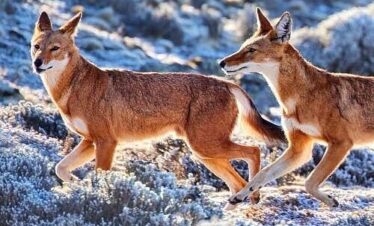
Walia Ibex are characterized by their chocolate-brown to chestnut-brown coat, greyish-brown muzzle, and white underparts. Males have large, backward-curving horns that can reach up to 110 cm in length, while females have shorter and thinner horns. Males also develop black beards as they age, distinguishing them from females.
These animals live in herds of 5 to 20 individuals, with mature males often partially separating from the main group except during mating season, which occurs from March to May. Walia Ibex are polygynous, meaning males mate with multiple females. They are herbivores, feeding on bushes, herbs, lichens, shrubs, and grasses, often standing on their hind legs to reach young shoots of giant heath.
The Walia Ibex faces significant threats, including habitat loss due to agricultural expansion, poaching, and competition with domestic livestock. Conservation efforts are underway to protect this species, with the Simien Mountains National Park serving as a critical stronghold for their survival. The park covers an area of 13,600 hectares and is crucial for the conservation of the Walia Ibex.
Other Trips
These are other trips.